
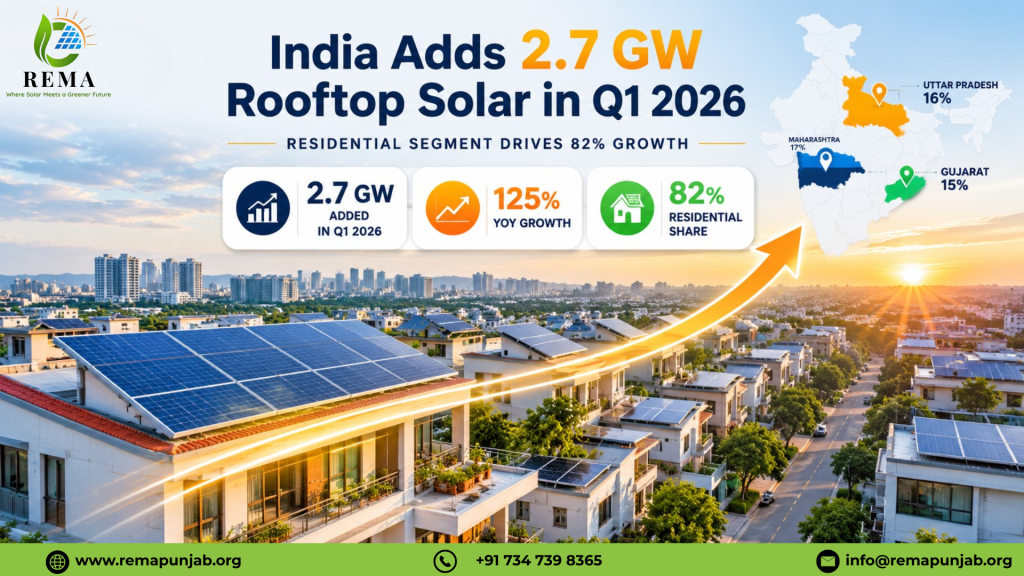
India added 2.7 GW of rooftop solar in just 90 days — a 125 percent jump year-on-year and 25 percent over Q4 2025. Cumulative capacity now stands at 23.5 GW as of March 2026, with rooftop solar accounting for 18 percent of all solar installations in the country.
These numbers mark a clear structural shift—solar is no longer just a utility-scale story. It is arriving on rooftops across neighborhoods and towns.
PM Surya Ghar: The Real Catalyst
The government’s PM Surya Ghar Muft Bijli Yojana scheme is the single biggest driver of this surge. By combining direct subsidies, simplified approvals, and stronger state-level support, the program has transformed who is buying solar in India.
The residential segment alone accounted for 82 percent of all Q1 installations. And 81 percent of those were under the capex model—meaning families are buying systems outright with subsidy backing, not leasing them.
This is not speculative demand. Real money is going on real rooftops across India.
Which States Are Leading—and Who Is Catching Up
Three states dominated Q1 additions:
- Maharashtra — 17%
- Uttar Pradesh — 16%
- Gujarat — 15%
Together, they account for nearly half of all new capacity. The top 10 states hold 80 percent of India’s cumulative installed base.
But the growth frontier is shifting—Assam clocked the fastest compounded quarterly growth rate at 40 percent, followed by UP and Andhra Pradesh. The scheme is reaching new geographies.
Segment Snapshot
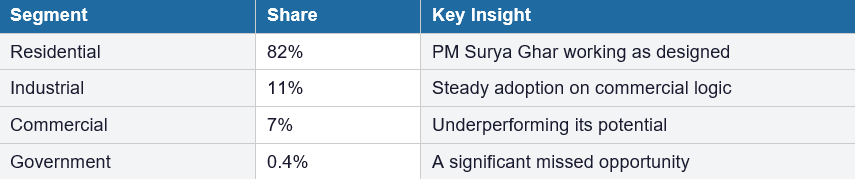
The government figure at just 0.4 percent stands out. India has thousands of public buildings with large rooftops and stable power demand—yet the public sector is barely participating. It remains one of the biggest untapped opportunities in the sector.
Watch the Pipeline
Tenders issued in Q1 fell 38 percent quarter-on-quarter to 482 MW, while auctioned capacity dropped 67 percent to 269 MW vs. Q4 2025. These are leading indicators—today’s thin pipeline becomes tomorrow’s softer installations.
Year-on-year figures remain positive, but the sequential decline warrants close monitoring through Q2.
Four Challenges That Will Define What Comes Next
Mercom Capital Group CEO Raj Prabhu identified the key constraints on sustained growth:
- Execution efficiency — installer capacity and approval processing must scale with demand
- Financing access—affordable solar loans for lower-income and rural households remain limited
- DISCOM coordination—net metering approvals and grid integration vary widely across utilities
- Grid readiness—Infrastructure built for one-directional flow must adapt to distributed generation
Conclusion:
Q1 2026 shows India’s rooftop solar market is not just growing—it is maturing. The fundamentals are strong: policy support, falling costs, rising tariffs, and expanding geographic reach. The challenges ahead are the kind that come with scaling something that is working.
The solar panels are going up. The harder work of building the ecosystem beneath them is just beginning.